Egochi Proprietary Tools
Egochi AI Qualifier Scores Your Pages for AI Search Citations
The Egochi AI Qualifier is our framework for scoring a page's AI citation readiness before AI engines score it for you. AI Overviews, ChatGPT, Gemini, and Perplexity answer by citing a short list of sources they trust, and they choose those sources on signals most pages never check: entity consistency, answer shape, schema depth, machine access, and whether the wider web agrees with what the page claims. The Qualifier runs every campaign page against those checks, names what is missing, and feeds the fixes into the plan. It is how Egochi clients end up named in AI answers instead of paraphrased without credit.
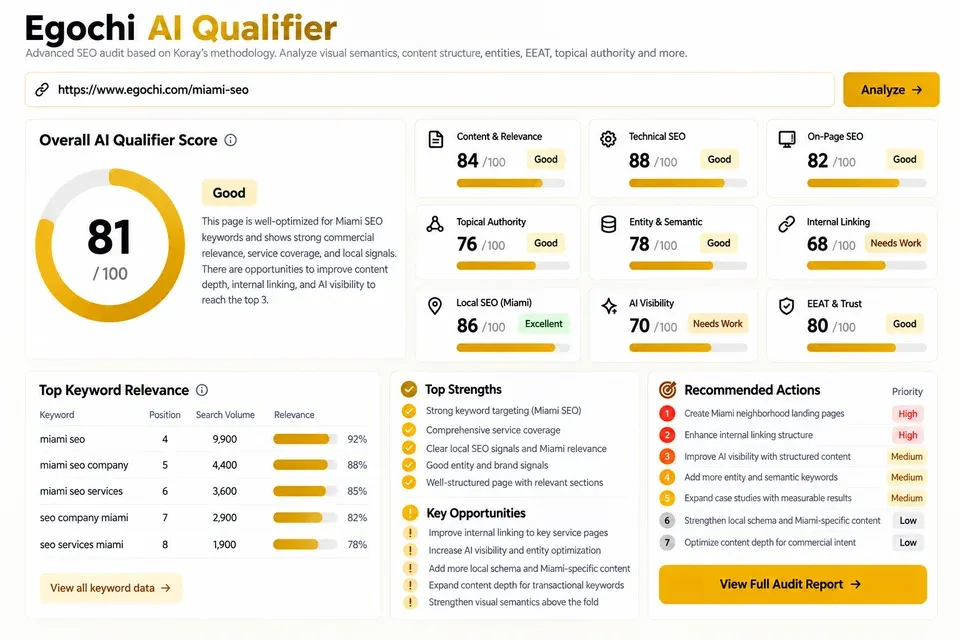
The Six Questions Every Page Must Pass
This is the actual framework, published. Run your own pages against it.
-
Entity consistency
Does every surface say the same thing about who you are, what you do, and where you serve: site, schema, Google Business Profile, and the wider web?
-
Answer-shaped opening
Does the page state its answer in the first sentences, in a form an engine can lift, or does the reader have to scroll for it?
-
Schema depth
Is the structured data complete and truthful: organization, service, FAQ, and the fields engines read before trusting a source?
-
Citable substance
Are there sourced figures, named facts, and first-hand material worth quoting, or only adjectives?
-
Machine access
Can AI crawlers reach the page at all: robots.txt allowances, llms.txt, and clean rendering without JavaScript walls?
-
Authority agreement
Do external sources, reviews, and coverage agree with what the page claims, so an engine citing you is not taking a risk?
What the Qualifier Checks
Six dimensions, each one a reason an engine cites a page or passes it over.
-
Entity Consistency
Your name, services, locations, and claims checked for agreement across the site, the schema, the Google Business Profile, and external profiles. Engines cite entities they can pin down.
-
Answer Shape
Openings tested for liftability: does the page answer the question in its first sentences, in words an engine can quote, before it expands?
-
Schema Depth
Structured data read the way engines read it: complete, truthful, and matched to the visible content, from the organization node to FAQ markup.
-
Citable Substance
Sourced figures, named facts, and first-hand material scored against the competition. A page with nothing quotable gives an engine nothing to cite.
-
Machine Access
Robots allowances for AI crawlers, llms.txt, and rendering checks, because a blocked or unreadable page cannot be cited no matter how good it is.
-
Authority Agreement
Reviews, coverage, and external references checked against the page’s claims, so citing you is the safe choice for the engine.
How the Qualifier Runs Inside a Campaign
Pages get qualified before they ship and re-qualified as engines change.
-
Qualify the page
Every money page gets scored across the six dimensions, producing a short, specific list of what would stop an engine from citing it today.
-
Close the gaps
The misses become work items: the defining sentence the opening lacks, the schema field that contradicts the page, the crawler rule blocking access. Specific fixes, not a vague AI strategy.
-
Watch the answers
We check which AI answers name your brand for the queries that matter, the same way we track rankings, and the findings go in your report.
-
Re-qualify as engines move
AI search changes faster than Google ever did. The qualifier dimensions get revisited as engines update, and pages that passed last quarter get checked again.
What do AI engines check before citing a source?
They lean on signals that look familiar from search: a clearly defined entity, content that answers in liftable sentences, structured data that agrees with the visible page, and external evidence that the source is trustworthy. The difference is strictness: an AI answer names only a handful of sources, so near-misses get nothing.
What is llms.txt?
A small plain-text file that describes your site and entity to AI systems, the way robots.txt speaks to crawlers. It is cheap to publish and still rare, and it is one of the machine-access checks in the Qualifier because telling engines who you are beats hoping they infer it.
How do you measure AI search visibility?
By checking the answers themselves: which queries trigger AI Overviews or chat answers in your category, and whether those answers name your brand. We track it the way rankings get tracked and report it beside them, because a citation you cannot verify is a citation you cannot claim.
A Framework We Run, Honestly Framed
The Qualifier is a framework our strategists apply, page by page, inside AI SEO engagements. We are not selling an automated AI score; we are showing you the checklist we actually work from, and the same checks power the AI readiness grades in our audit engine.
Inside the EGOCHI VERTEX™ methodology it gates the content and schema stages: nothing ships to a money page without passing the questions below.
Is Egochi AI Qualifier Right for You?
This is for you if
- Your buyers ask AI tools for recommendations, and competitors are getting named while your pages get paraphrased without credit.
- You already rank in Google and want that authority translated into AI Overview and chat citations before the gap widens.
- You want AI search handled with named checks and visible fixes, not a slide that says AI a dozen times.
When this may not be the right fit
- Your category rarely triggers AI answers yet. We will tell you that, and local or organic work will earn more this year.
- You expect a guaranteed placement inside a specific AI answer. Nobody controls those systems, and anyone promising placement is guessing on your budget.
The Rest of the Egochi Tool Family
Egochi AI Qualifier works beside the other systems Egochi built. Each has its own page.
Egochi AI Qualifier Questions
What is the Egochi AI Qualifier?
The Egochi AI Qualifier is our framework for scoring a page’s readiness to be cited by AI search: entity consistency, answer shape, schema depth, citable substance, machine access, and authority agreement. Every Egochi campaign page gets qualified against it, and the misses become specific work items.
Is this a software product?
It is a working framework our team applies, supported by our own tooling, including the AI readiness checks inside the Egochi Audit Engine. We publish it because a checklist you can read is more credible than an AI badge you cannot.
How is this different from normal SEO?
It overlaps on purpose: engines cite pages that already demonstrate authority. The Qualifier adds the AI-specific layer on top, such as liftable answer openings, llms.txt and AI crawler access, and entity agreement across surfaces, which classic on-page checklists never look at.
Can you prove AI citations happen?
We track which AI answers name our clients and report it. Egochi client pages are cited today in Google AI Overviews and ChatGPT answers, including a Manhattan endodontics practice and a Greensboro family law firm named for their money queries, and our own entity is quoted in AI Overviews.
Where do I start?
With the free audit: its AI readiness section runs a first pass of these checks automatically and shows your gaps on screen. The full Qualifier work happens inside an engagement, page by page.
Find Out What AI Engines See Before They Decide
Ask for a free proposal and your top pages come back qualified: what an engine can cite today, what blocks it, and the order we would fix it in. If your category is not AI-contested yet, the proposal says that and points the budget where it earns more.